

Article
Data Center Water Treatment Indonesia
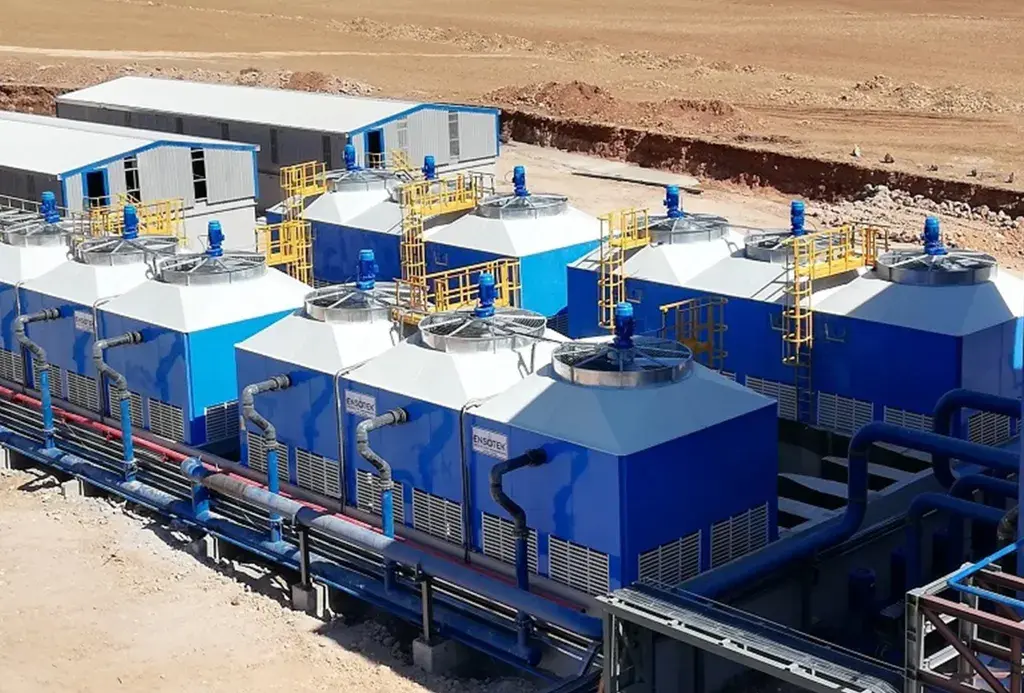
Data center water treatment covers three jobs. The first is producing reliable make-up water for the cooling plant. The second is controlling cooling-tower and closed-loop chemistry so heat exchangers stay clean. The third is managing blowdown so water consumption and discharge costs stay low. PT Beta Pramesti Asia develops the basis from the source, cooling configuration, load, and discharge route.
Data center water treatment protects three different circuits
Open cooling towers, closed chilled-water loops, and liquid-cooling loops should not receive one water specification or chemical programme. A cooling tower loses water through evaporation and blowdown. A closed loop needs corrosion and circuit-cleanliness control. Liquid cooling adds material and cleanliness limits for cold plates or micro-channels.
In an open circuit, evaporation concentrates the minerals left in the recirculating water. The treatment programme must control scale, corrosion, sediment, and microbiological growth. It also has to respect material compatibility and the blowdown route.
What should be reviewed for a data center cooling water treatment proposal?
Start with dated make-up-water analysis, normal and peak demand, each circuit configuration, materials, availability, target cycles of concentration, current WUE, and the blowdown route. This separates a testable design from a generic chemical quotation. The CDC cooling-tower water-management guidance also identifies scale, corrosion, sediment, and microbiological control as core programme elements.
| Buyer input | Decision the review must produce | Commissioning evidence |
|---|---|---|
| Dated source and make-up analyses, including seasonal variation | Pretreatment, make-up specification, recovery, and redundancy | Product quality, net capacity, recovery, and backwash or reject flow |
| Cooling-tower, chilled-water, and liquid-cooling diagrams with materials | Chemistry, dosing points, sensors, alarms, and control limits for each circuit | Calibration, interlock response, chemical residual, conductivity, and corrosion trend |
| Heat load, evaporation, make-up, blowdown, and WUE across operating cases | Water balance, testable COC, storage demand, and reuse opportunity | Actual water balance at the agreed load and a functioning blowdown route |
| Availability target, duty/standby basis, maintenance access, and chemical inventory | Train arrangement, bypasses, sampling access, minimum stock, and upset response | Changeover test, SOPs, startup logs, training, and closed punch-list items |
1. Make-up water: start with water quality
Make-up sources in Indonesia vary. They can be municipal supply, groundwater, surface water, even seawater at coastal sites. The source quality dictates the pre-treatment:
- Turbidity and particles are removed with media filters (sand/multimedia) and cartridge filtration.
- High hardness scales a cooling tower quickly at low cycles of concentration (COC). Use a softener or upgrade the water with reverse osmosis.
- High-TDS or brackish sources warrant an RO evaluation. It compares recovery, energy, antiscalant, cleaning, reject flow, and cooling-tower chemistry limits.
- Precision loops (chilled water, liquid cooling) call for demineralized water. See demineralizer systems for low-conductivity specifications.
More stable make-up may allow higher COC and lower blowdown. The limit still has to be calculated from water analysis, materials, the chemical programme, and discharge requirements.
2. Cooling towers: the core chemical program
Data center cooling towers run 24/7 all year. Therefore the program has to be stable, not seasonal. The components we run under cooling tower chemicals:
- Scale inhibitors keep calcium carbonate and silica dissolved as COC is pushed up.
- Corrosion inhibitors protect carbon steel piping, copper heat exchangers, and galvanized basins.
- Biocides control bacteria, algae, and biofilm. They work by alternating oxidizing and non-oxidizing types. Any biofilm is both a heat insulator and a breeding ground for bacteria including Legionella. Every cooling-tower facility must manage this risk.
- Dispersants keep particles suspended until they leave with the blowdown.
Dosing should be automated on conductivity and make-up volume. It should also have continuous monitoring such as Betaqua Sentinel CTS. Then corrosion trends, conductivity and chemical inventory are visible before they become problems.
3. Closed loops and liquid cooling
Chilled water loops, closed condenser loops, and direct-to-chip liquid cooling should lose no water. However, these are the systems most neglected until corrosion or microbiological fouling appears. Good practice: fill with demineralized or softened water, dose closed loop chemicals (nitrite/molybdate or non-metal corrosion inhibitor formulations plus a non-oxidizing biocide), then monitor periodically: conductivity, inhibitor level, dissolved iron and copper, and bacteria counts.
This monitoring gives early warning when corrosion, inhibitor loss or contamination begins to develop. Corrective work can then start before deposits or corrosion products interfere with cold plates, pumps, chillers or micro-channels.
4. WUE and how to reduce water consumption
Water Usage Effectiveness (WUE) compares annual water use with IT-equipment energy. Keep the measurement boundary consistent so changes remain comparable. Where water quality and permits allow, the U.S. Department of Energy also identifies RO treatment of cooling-tower blowdown as an option for offsetting freshwater demand. Evaluate the options in this order:
- Review the COC limit. Higher COC can reduce blowdown. However, the new limit must pass scale, corrosion, silica, materials and discharge checks.
- Improve make-up water. Compare softening, RO, or both against the water balance, energy, chemistry and reject route.
- Test blowdown-reuse feasibility. Evaluate filtration or RO together with recovery, cleaning, concentrate and permit implications.
- Use alternative water. Rainwater, treated effluent from an estate sewage treatment plant, or reclaimed water.
5. Blowdown and data center wastewater
Blowdown carries concentrated TDS and chemical residues. A facility also produces domestic wastewater and filter backwash. Environmental permits need these streams managed, with neutralization, settling or light biological treatment. For office and NOC domestic wastewater, a packaged compact STP fits well. PT Beta Pramesti Asia covers both the chemistry and the equipment, so we can engineer a site’s water balance from make-up through discharge.
FAQ
Does a data center have to use cooling towers? No. Air-cooled chillers, evaporative cooling and free cooling have different energy, water, space and climate dependencies. Selection should follow load, location, availability targets, water constraints and the facility’s mechanical design.
What is a reasonable COC target? There is no single target for every data center. Set COC from make-up and recirculating-water analyses, scale and corrosion potential, materials, the chemical programme, blowdown limits and operating evidence.
How does cooling tower treatment differ from closed loop treatment? An open cooling tower needs continuous scale, corrosion and microbiological control with routine blowdown. A closed loop is filled once and focuses on corrosion inhibitors and bacterial control with no water loss.
Can a program start at a facility already in operation? Yes. A water chemistry audit, deposit inspection and cleaning (cooling tower cleaning service) come first. Then the maintenance program takes over.
Need a data center water treatment program, from make-up water design and chemical treatment to monitoring? Contact the PT Beta Pramesti Asia team via the contact page.