

Mining
Heavy Duty Water-Based Degreaser for Heavy Equipment
Updated
Heavy duty water-based degreaser lifts oil, grease, soot and light tar from heavy equipment, trucks and workshop floors, then rinses away.
Discuss the application.
Send the application, operating conditions and the result you expect. Our team will discuss the options with you.
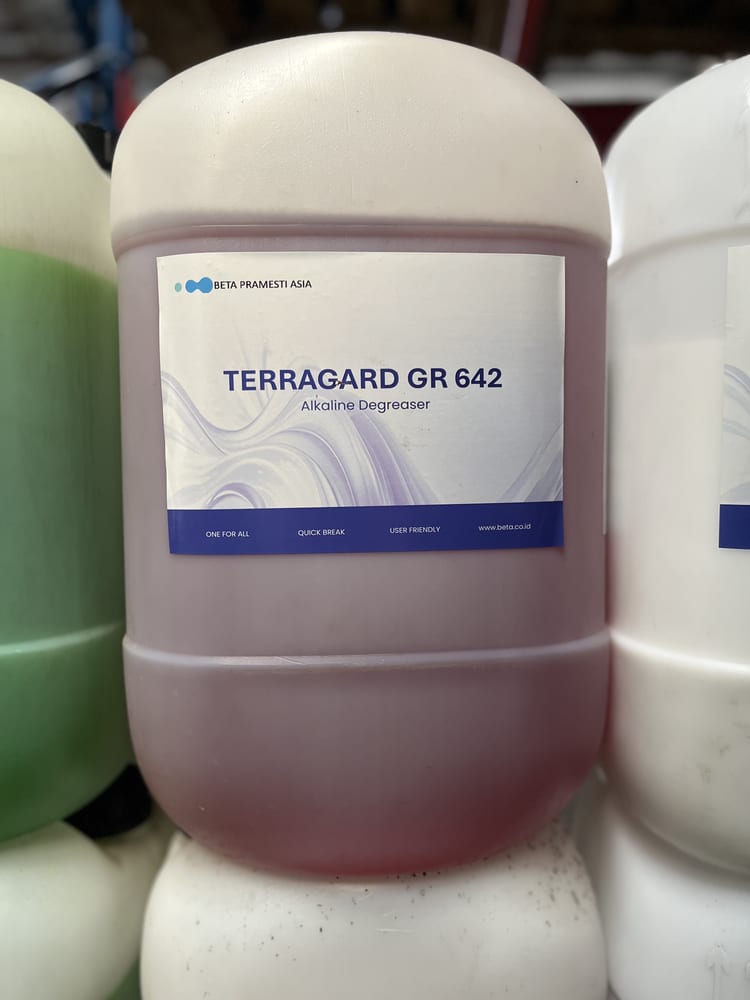
A heavy duty water-based degreaser is an industrial cleaner. You dilute it with water to lift oil, grease, soot and light tar from heavy equipment, trucks, engines and workshop floors before rinsing. It is used for routine washing where the fire risk must be lower than with solvents. PT Beta Pramesti Asia supplies water-based degreasers, including the alkaline TERRAGARD GR 642, with on-site trial support.
Updated: 12 November 2026.
This page is part of the TERRAGARD degreaser guide. That guide compares water-based, quick-break and solvent degreasers.
What jobs is a water-based degreaser used for?
- Removing oil and grease from bodies, undercarriages and engine bays of heavy equipment and trucks in a wash bay.
- Cleaning workshop floors, maintenance bays and concrete surfaces with oil spills.
- Cleaning oil and dirt from condensers, mixing tanks, heat exchangers, pipes and fan-coil units, as listed on the TERRAGARD GR 642 data sheet.
- Removing oil residue inside holding tanks.
- Preparing surfaces before inspection, mechanical repair or painting.
How does a water-based degreaser work?
Surfactants and wetting agents lower surface tension so the detergent penetrates the oil film. Alkaline components help break up and emulsify oil and grease, so the soil moves into the detergent and leaves with the rinse. Heating the detergent, circulation, and brushing or pressure spraying speed up the product on heavy soils.
Because the oil leaves as an emulsion, the wash water needs attention. If the wash bay drains to an oil-water separator that usually passes oil, compare with a quick-break degreaser. For components that must stay dry or need soaking, see the solvent base degreaser.
Water-based vs solvent vs quick-break degreaser
The three TERRAGARD degreaser types are chosen by the soil you face, the work surface, the rinse you can give it and where the wash water goes.
| Criterion | Water-based (heavy duty) | Solvent-based | Quick-break |
|---|---|---|---|
| Typical soils | Oil, grease, soot, light tar | Heavy grease, hardened oil, tar, dirt on engine components | Oil and grease in routine washing |
| Surfaces | Steel, concrete floors, equipment bodies; test first on aluminium, paint and rubber because the product is alkaline | Metals and well-bonded paint per the EXSO data sheets; test on rubber, plastics and coatings | As water-based; test material compatibility |
| Rinse | Rinsed with water | No water rinse; evaporates or is wiped off, so it dries fast | Rinsed with water |
| Oil-water separator | Oil leaves as an emulsion, so check what the separator and treatment plant can take | Never sent to the separator; spent solvent and rags are collected separately | The emulsion breaks in the separator and a skimmer takes the oil |
| Where it is used | Wash bays, workshop floors, heavy-equipment exteriors and undercarriages, tanks and heat exchangers | Component workshops, parts soak tanks, areas that must stay dry | Wash bays with a sump or oil-water separator |
Use the water-based type where cleaning repeats and rinse water is available. Move to a solvent base degreaser when components must dry fast or cannot be rinsed with water, and to a quick break degreaser when the separator keeps passing oil. The full guide to all three types is in the TERRAGARD degreaser guide.
TERRAGARD GR 642 technical data (water-based alkaline degreaser)
| Parameter | Value |
|---|---|
| Type | Water-based alkaline degreaser |
| Appearance | Clear yellow liquid |
| Specific gravity | 1.00-1.10 (20°C) |
| pH | 8.5-9.5 |
| Solubility | Completely soluble in water |
| Application | Spray, dip or immerse, or brush |
| Dilution | Depends on the degree of soiling; the data sheet gives usual dilutions of 1:10 to 1:40 |
| Handling | Alkaline and may irritate eyes; wear goggles and gloves |
| Packaging | 30 kg plastic container, 200 kg drum, or 1,000 kg IBC |
Working dilution arithmetic: product volume = wash volume ÷ (parts of water + 1). Example: at 1:20, a 210-litre tank needs 10 litres of product and 200 litres of water. This only shows the calculation. The final dilution is set by the site trial.
Which data drive the recommendation?
| Data to check | Effect on the recommendation |
|---|---|
| Contamination type | Hydraulic oil, grease, soot, coolant, or light tar need different dilution and contact time |
| Work surface | Metal components, concrete floors, heavy equipment, and paint-prep areas differ in residue risk and rinse need. Test first on aluminium, paint, and rubber because the product is alkaline |
| Application method | Spraying, brushing, mopping, or soaking sets working concentration and site safety procedures |
| Rinse water | If rinse water carries oil, plan separation through oil removal or a grease trap before the wastewater plant |
How do you trial a degreaser on site?
A trial should measure cleanliness, contact time, product use, worker safety and wash-water impact. A product that looks strong on one surface may not suit the whole workshop. It may leave residue, upset the separator, or need too much rinsing.
| Trial step | Data recorded | Decision |
|---|---|---|
| Choose the trial area | Oil or grease type, material, area, temperature, soil level | The area must represent routine work, not the easiest spot |
| Set the dilution | Concentration, product volume, application method, contact time, brushing or water pressure | Compare cost per job from actual use, not price per litre |
| Assess the rinse | Slippery residue, remaining stains, drying time, need to re-rinse | Accept, adjust concentration, or move to quick-break or solvent if results are unstable |
| Check the wash water | Water volume, oil and grease, emulsion, pH, separator or plant response | Proceed only if the oil-separation route can take the load. Samples can be tested through lab.id |
A fuller trial guide is in how to choose the right degreaser for mining machinery.
What should you send us for a quotation?
- Oil or grease type, and photos of the soiling.
- Number of units or floor area cleaned per week.
- Current cleaning method and the equipment you have (pressure washer, steam, soak tank).
- Sensitive materials on the equipment.
- Where the wash water goes: sump, oil-water separator, wastewater plant.
- Delivery location and preferred packaging.
Send these details through our technical team.
Frequently asked questions about heavy duty degreasers
What is a water-based degreaser?
A water-based degreaser is an industrial cleaner. Water is the main carrier. It helps surfactants lift oil, grease and oily dirt from work surfaces. It suits workshops, heavy equipment and plant areas that need routine cleaning with lower fire risk than many solvent cleaners.
When should I choose water-based over solvent?
Choose water-based when the area needs repeated cleaning, rinse water is available, and the wash water can be treated. Some components must dry fast, cannot be rinsed with water, or need soaking. For those, compare with the solvent base degreaser.
Is a water-based degreaser strong enough for mining equipment?
It can be. It depends on the formulation, the contaminant, the temperature, the contact time and the agitation. Remove thick grease and mud first. Then compare the results with your current method on a representative area.
Can wash water be discharged directly?
No. Wash water carries oil, solids and degreaser residue. Route it to an oil-water separator or suitable treatment. Classify the wash water, the separator sludge and the recovered oil according to the environmental approvals that apply on site.
What information should I prepare before asking for a recommendation?
Prepare the oil or grease type, the surface materials, the soil level, the application method, whether rinse water is available, and how the wash water is treated. Beta’s team reviews these before recommending a product and starting dilution.
Related products: TERRAGARD Degreasers (all types), Quick Break Degreaser, Solvent Base Degreaser.