

Mining
TERRAGARD Dust Suppressant for Mines in Indonesia
Updated
TERRAGARD dust suppressant for mine haul roads, stockpiles, and conveyors. Save water and water truck trips, cut dust-related stoppages. Dispatched within 3 business days.
Need it fast? Our stock is ready to ship.
Our stock is ready for fast delivery.
- Dispatched within 3 business days of PO
- Talk directly with our technicians
- Zoom or in-person meetings
- Measured field trial on your site
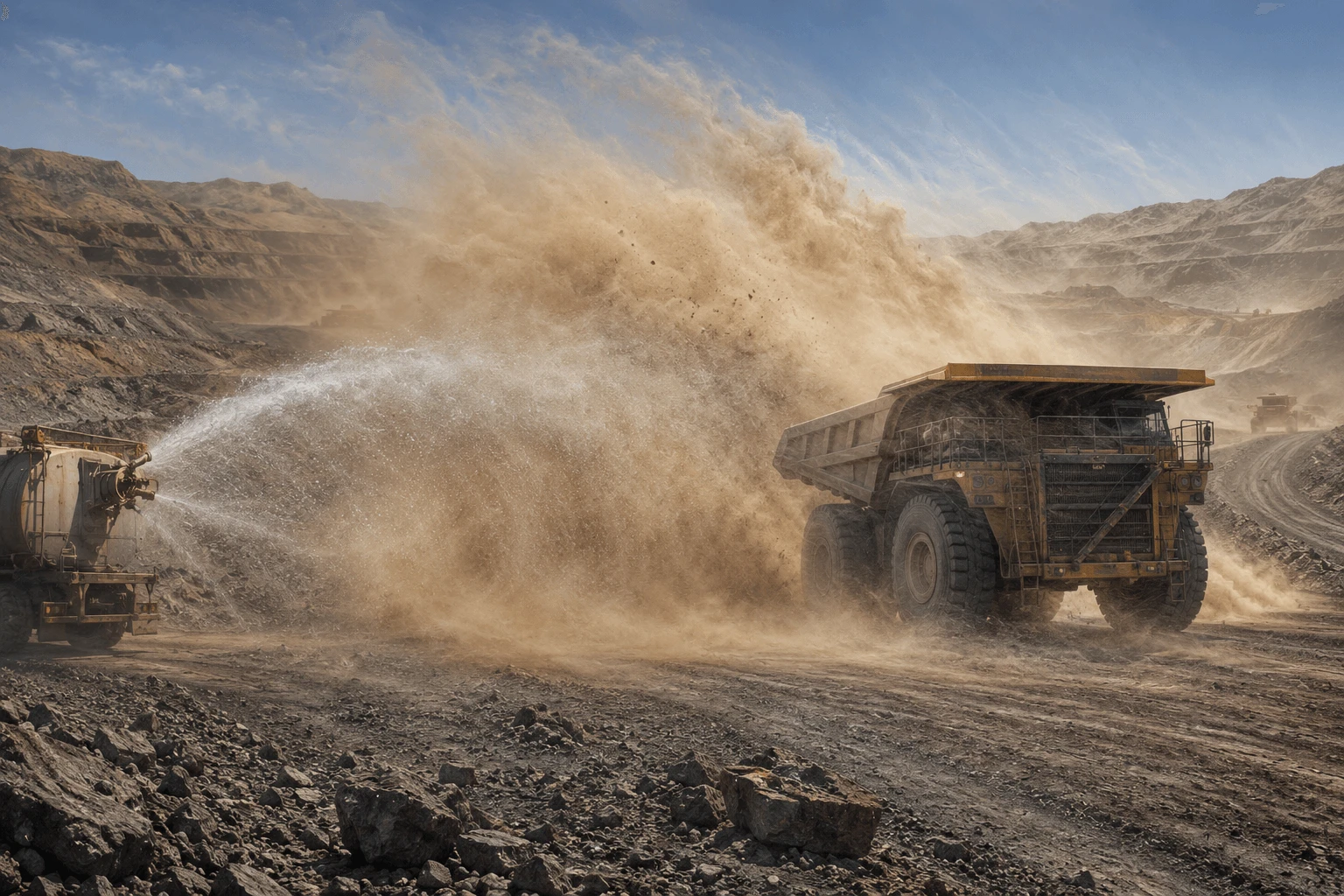
Dust on haul roads is not just a housekeeping problem. It slows production, overloads your water truck fleet and puts operators at risk. TERRAGARD from PT Beta Pramesti Asia is a range of chemical dust suppressants for mine haul roads, coal stockpiles, conveyor transfer points and crushers. It makes every litre of water work longer. Therefore dust stays under control with less water, fewer watering trips and fewer lost operating hours.
- ✅ Stock ready to ship: dispatched within 3 business days of PO.
- ✅ Technician support: technical discussion via Zoom or in person before and during application.
- ✅ Proven on your site: every program starts with a measured field trial against your water-only baseline.
- ✅ Supplied by specialists: PT Beta Pramesti Asia has served water treatment and industrial chemical customers since 1985.
Request a quote via WhatsApp →
Updated: 12 November 2026.
What is a mining dust suppressant?
A mining dust suppressant is a chemical added to watering water. It wets dust particles faster, binds fine particles to the surface and holds moisture longer. Dust from haul roads, stockpiles, conveyors and crushers then stays under control with less frequent watering than water alone. It is applied with existing water trucks or spray systems. PT Beta Pramesti Asia supplies TERRAGARD dust suppressants in Indonesia, with stock and technical support for mine sites.
Why do mines need a dust suppressant?
Watering alone is the most common fix, and also the one that wears off fastest. Under strong sun and constant dump truck traffic, water evaporates quickly and dust comes straight back. Therefore the dust returns within hours.
- Safety at risk. Heavy dust reduces operator visibility, especially at bends, intersections and two-way roads. When visibility drops, hauling has to slow down or stop.
- Lost production. Every hour units wait for dust to settle is tonnage that is not moved.
- Rising water and water truck costs. Water trucks run continuously. This adds fuel, operating hours, drivers, maintenance and water supply.
- Faster equipment wear. Dust accelerates wear on air filters, radiators, brakes and moving parts. It also adds to road maintenance costs.
- Health and community relations. Dust exposure is a risk for workers. Complaints from nearby communities can become a permitting issue.
A dust suppressant does not replace water. It makes water work harder and last longer.
How does TERRAGARD work?
TERRAGARD is mixed directly into your water truck tank or existing spray system. You do not need to invest in new equipment.
- Lowers water surface tension. Wetting agents help water penetrate the road surface faster and reach fine dust particles, including hard-to-wet coal dust.
- Binds fine particles. Synthetic polymer resins help hold dust particles in place, so tyres and wind do not lift them again easily.
- Retains moisture longer. Once absorbed, the treated layer slows evaporation and keeps the road sub-layer moist.
- Cumulative effect. With repeated applications, subsoil moisture is retained longer. Therefore watering intervals can be extended, based on trial results, soil type, traffic and weather.
Haul road, stockpile, conveyor, or crusher: what is the difference?
Each area releases dust in a different way. Therefore the product, the application method and the measure of success also differ.
| Area | How dust forms | Application | TERRAGARD product | What is measured | Detail page |
|---|---|---|---|---|---|
| Haul roads and mine roads | Dump truck tyres grind the surface; vehicle turbulence and wind lift fine particles | Water truck with spray bar, dilute solution, initial treatment then regular maintenance | STR 750 or STR 754 | Watering interval, water truck trips, visibility, traction | Haul road dust suppressant |
| Coal stockpiles | Wind erosion and repeated disturbance of the pile surface | Manual spraying of the pile surface | ST 700 | Dust in high wind, surface coverage, effect on reclaim | Coal dust suppressant |
| Conveyors and transfer points | Free fall, impact, and air movement in chutes | Conveyor sprayers at transfer points | ST 700 | Transfer-point dust, material moisture, nozzle condition | Coal dust suppressant |
| Crushers, truck loading, and barge loading | New fines released when material is crushed, dropped, or loaded | Conveyor sprayers at crusher units or loading systems; nozzle positions set after inspecting the dust source | ST 700 | Dust at the release point, spray coverage, process impact | Coal dust suppressant |
The TERRAGARD ST 700 data sheet lists application through conveyor sprayers, including crusher units and barge loading systems. It also lists manual spraying at truck loading and unloading points, stockpiles or barges.
How does a dust suppressant compare with water-only spraying?
| Aspect | Water only | Water + dust suppressant |
|---|---|---|
| Wetting fine dust | Slow on hard-to-wet coal dust | Wetting agents lower surface tension so water penetrates faster |
| Duration | Gone once the water evaporates | Moisture lasts longer; repeated application has a cumulative effect on the road sub-layer |
| Fine particles | Lifted again once dry | Polymer resins help hold particles on the surface |
| Watering frequency | High, especially at midday and in the dry season | Intervals can be extended once proven in a trial |
| Slip risk | Appears with overwatering | Still present with overwatering; controlled through dilution and volume, especially at bends |
| Cost | Water, fuel, drivers, and water truck maintenance | Plus product cost, weighed against fewer trips and fewer stoppage hours |
A fuller comparison is in the article chemical dust suppressant vs water spray.
How much can you save?
The real cost of dust rarely shows up in the price per litre. The biggest costs come from slowed or stopped operations and from a water truck fleet that never stops running. Compare the two scenarios:
| Cost component | Water only | TERRAGARD program |
|---|---|---|
| Downtime from poor visibility | Hauling slows or stops in heavy dust | Better dust control, lower risk of stoppages |
| Water truck trips | Repeated watering throughout the shift | Longer intervals once proven in a trial |
| Water consumption | High, especially in the dry season | More efficient, water penetrates and lasts longer |
| Water truck fuel, drivers, and maintenance | Tied to the number of trips | Falls as trips are reduced |
| Equipment wear and road maintenance | Filters, radiators, and road surfaces wear quickly | Fines held on the surface |
| Product cost | None | Yes, and weighed against the savings above |
Estimate the savings on your site
Use these simple formulas with your operating data:
- Downtime loss = hours of hauling stopped or slowed by dust × productivity (tonnes/hour) × margin per tonne
- Watering cost = water truck trips per day × cost per trip (fuel, driver, maintenance, water)
- Potential savings = (downtime loss + watering cost before the program) − (downtime loss + watering cost + TERRAGARD product cost after the program)
Compare the value of one hour of stopped hauling with the daily product cost. That is usually where the savings appear. Send us your water truck trips, dust-related stoppage hours and fleet productivity. Our technicians will help estimate the savings before the field trial starts. Trial results on your site always prove the final figures.
Why is dust control more important than ever?
- Stricter environmental regulation. Indonesia’s Government Regulation (PP) No. 22 of 2021 on environmental protection and management sets ambient air quality standards, including PM10 and PM2.5 particulates. Documented dust control helps you meet environmental permit requirements.
- Good mining practice. Minister of Energy and Mineral Resources Decree No. 1827 K/30/MEM/2018 sets out mining safety and environmental management rules. A measured dust control program helps you meet these obligations.
- ESG expectations from buyers and financiers. Coal buyers, investors, and lenders increasingly look at the environmental and health-and-safety performance of mining operations.
- Water is more valuable. Long dry seasons limit water available for watering. Every litre has to work harder.
- Worker health. The NIOSH 2021 coal mine dust control guidance treats dust suppression as part of a set of engineering controls, maintenance, and exposure monitoring.
- High production targets. As tonnage targets rise, there is no room for operating hours lost to dust.
The TERRAGARD range
TERRAGARD STR 750: Road dust control
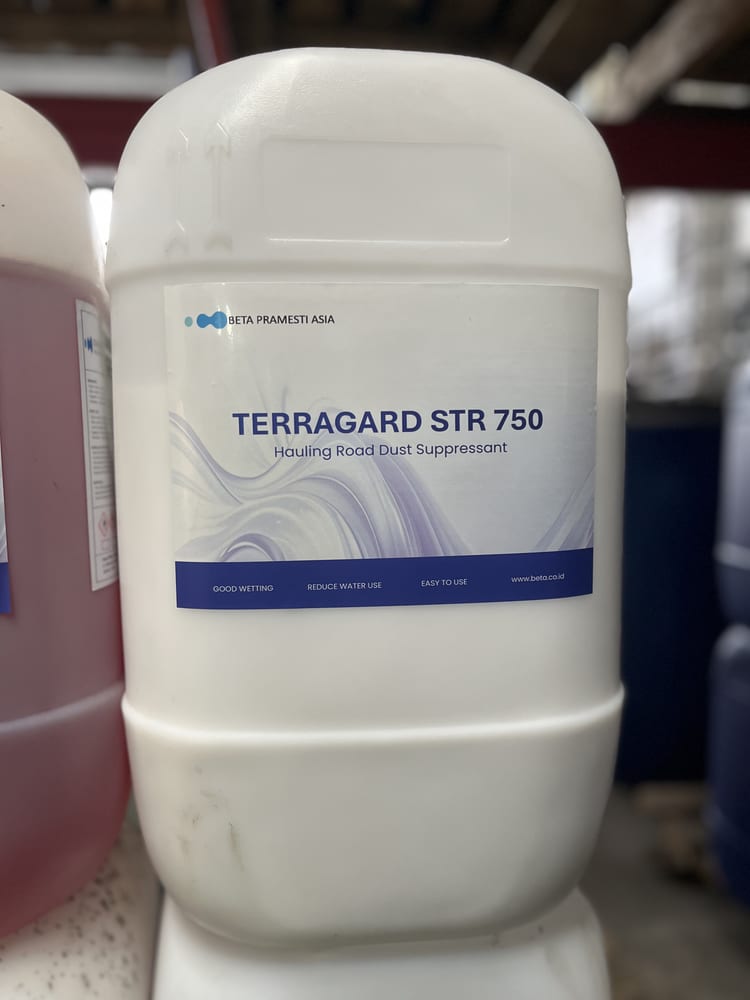
A dispersion of synthetic polymer resins, wetting agents and additives in water for haul roads and dusty surfaces. It accelerates water penetration and improves water retention on the road surface. Repeated applications can reduce the water required for dust suppression and keep subsoil moist for longer.
- Easy to apply directly from the water truck tank.
- Improves water penetration for more effective dust suppression.
- Keeps subsoil moist longer with repeated applications.
| Parameter | Value |
|---|---|
| Physical form | Milky white emulsion |
| Specific gravity | 0.95–1.05 |
| pH | 6.0–8.0 |
| Solubility | Miscible with water |
| Initial application | Add after the water tank is filled to limit foaming; truck movement assists mixing, and a dosing pump can be used. Preliminary dilution 0.1–0.3% in water, maximum coverage 1–2 litres of solution per m² per watering. Traffic does not need to stop for watering. |
| Initial schedule per data sheet | Day 1: 6 waterings 60 minutes apart so the mix can soak in; day 2: 5; day 3: 4; day 4: 3; day 5: 2–3, at the same interval. Adjust to soil type, traffic, and weather. |
| Storage | Closed HDPE containers. Exposure to hot, dry air can form a skin on the concentrate. Read the current label and SDS. |
| Packaging | 25-, 200-, or 1,000-litre HDPE containers |
TERRAGARD STR 754: Road dust control
A dispersion of synthetic polymer resins, wetting agents, and additives in water. When applied properly, it lets you use less water for dust suppression. Repeated applications have a cumulative effect, so the subsoil stays moist for longer.
- Higher water retention on the road surface.
- Keeps subsoil moist for longer periods.
- Applied with your existing water trucks.
| Parameter | Value |
|---|---|
| Physical form | Milky white emulsion |
| Specific gravity | 0.97–1.07 |
| pH | 6.0–8.0 |
| Solubility | Miscible with water |
| Initial application | Dilute 1–5 litres of product in 1,000 litres of fresh water; 1 litre of solution covers 1–3 m². Preliminary guidance: spray 3–5 times per day for initial treatment and 1–3 times per day for follow-up. Avoid overwatering, especially at bends. Adjust the interval from trial results. |
| Storage | Closed HDPE containers. Exposure to hot, dry air can form a skin on the concentrate. Read the current label and SDS. |
| Packaging | 25 kg, 200 kg, or 1,000 kg IBC |
TERRAGARD ST 700: Coal dust control
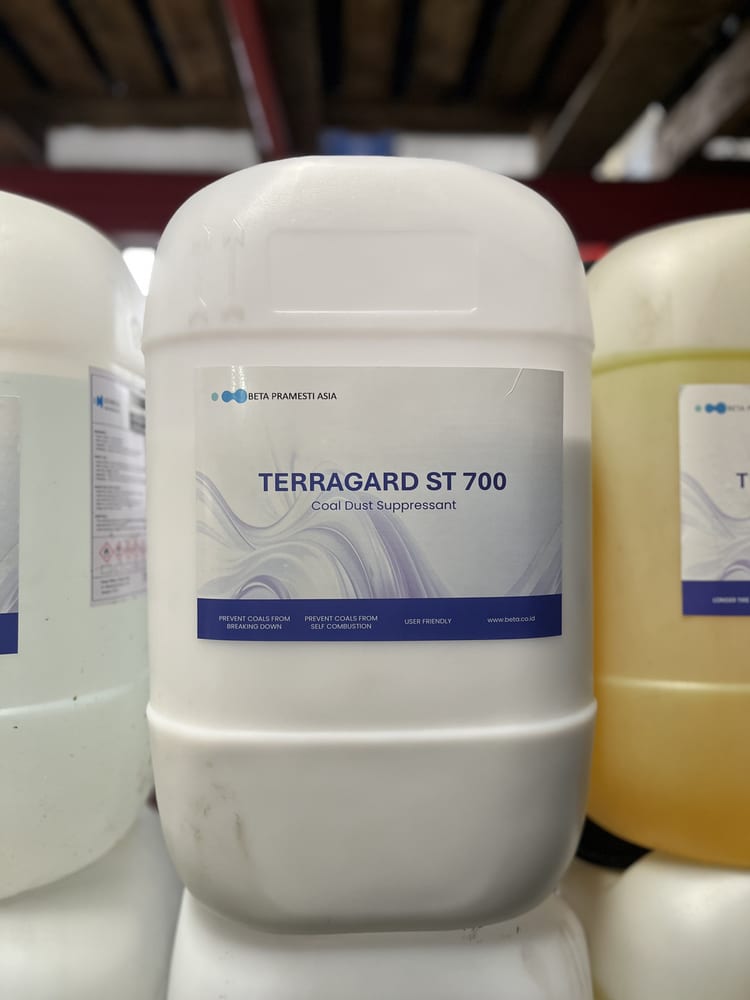
An emulsion for coal dust suppression at conveyor transfer points and stockpiles. It helps the product wet and hold fine particles on the material surface.
- For coal conveyor transfer points and stockpiles.
- Preliminary dilution range available for field trial planning.
- Supplied in 200-litre PE drums.
| Parameter | Value |
|---|---|
| Physical form | Milky white emulsion |
| Specific gravity (25°C) | 0.95–1.10 g/cm³ |
| pH (neat) | 6.0–8.0 |
| Initial application | Transfer points: 0.2–1% dilution in water; 60–100 litres of solution per 10–20 tonnes of coal. Stockpiles: 0.2–1% dilution; 2–3 litres of solution per m³ of stockpile surface area. |
| Storage | Dry, ventilated premises protected from direct sunlight. Inadequate conditions or prolonged storage may reduce performance. Read the current SDS. |
| Packaging | 200-litre PE drums |
The concentrations above are starting points from the product data sheets. Final dosage, coverage and interval are set through a field trial.
How is a dust control programme set?
A good programme is set from site measurements, not from generic figures.
- Trial and control sections. Choose two road sections (or two transfer points) with similar traffic, material, and sun exposure. The control section stays on water only.
- Baseline. Over several days, record water truck trips per shift, water volume, dust at the same times of day, and hours of hauling slowed or stopped by dust.
- Starting dilution. Start from the data-sheet range. STR 750 is 0.1–0.3%. STR 754 is 1–5 litres of product per 1,000 litres of water. ST 700 is 0.2–1%. Worked example: a 20,000-litre water truck at 0.2% needs 40 litres of STR 750.
- Measure the application rate, do not guess it. Rate (L/m²) = spray bar flow (L/min) ÷ (truck speed (m/min) × spray width (m)). Measure actual flow and speed, then compare with the data-sheet coverage.
- Watering interval. Rewater when dust starts to show again on the trial section and record the time. This interval decides how many trips can be saved.
- Water truck savings. Compare trips and water volume per shift on the trial section against the control section, then multiply by your cost per trip.
- Adjust. Raise or lower concentration and interval step by step until the target is met at the lowest total cost, then extend to the whole road.
For conveyors, crushers and coal stockpiles, the steps for setting the application rate and interval are on the coal dust suppressant rate and interval guide.
From consultation to measured results: how we work
- Technical consultation. Talk with our technicians via Zoom or in person about your road conditions, fleet, water source, and targets.
- Product recommendation and demand estimate. We select the right TERRAGARD product and estimate initial requirements.
- Fast delivery. Stock ready to ship, dispatched within 3 business days of PO.
- Controlled field trial. A treated segment is compared with a control segment under similar traffic and weather. We record dust, water volume, watering frequency, traction, and surface condition.
- Evaluation and optimisation. Concentration and interval are adjusted step by step until the target is met at the lowest total cost.
Success criteria agreed up front
| Area | What is measured | When the trial is stopped |
|---|---|---|
| Dust control | Measurement points, method, observation time, and target relative to baseline | Baseline is unrepresentative or trial conditions cannot be compared |
| Water and interval | Solution volume, concentration, area, and rewatering demand | Volume or frequency is not recorded |
| Road safety | Traction, braking, bends, drainage, visibility, operator feedback | Slippery surface, ponding, or operating risk exceeds the project limit |
| Process impact | Carryback, material moisture, nozzle condition, compatibility | Product affects material, equipment, or product quality |
| Commercial decision | Product, water, equipment, labour, delivery, and cost per trial basis | Offers do not use the same coverage and period basis |
Compare dust suppressant offers on total field cost per controlled area or tonnage, not just the price per litre of concentrate. The CDC haul road dust control guide also says that road structure, traffic, application, maintenance, and actual cost are linked.
Request a quote now
To prepare your quote and savings estimate quickly, please share the following. Even partial data is enough to start:
- Application area: haul road, stockpile, conveyor, or crusher. Road length and width or area.
- Traffic: number and type of units, trips per hour or per day.
- Current watering: number and capacity of water trucks, watering frequency, water source and quality.
- Dust impact: estimated hours of hauling stopped or slowed by dust.
- Site conditions: road material, weather, photos or videos of current dust.
- Delivery location and target schedule.
Stock ready to ship, dispatched within 3 business days of PO. Talk to our technicians about your needs and book a Zoom or in-person meeting.
Request a quote via WhatsApp → or contact our team.
For more specific needs, see also haul road dust suppressant, coal dust suppressant for conveyors and stockpiles, the chemical dust suppressant vs water spray guide, environmental impacts of dust control chemicals in mining, our mining chemicals references, and our mining chemicals range.
Frequently asked questions about mining dust suppressants
What is a dust suppressant?
A dust suppressant is a dust control chemical that is added to watering water. Wetting agents help the water penetrate dust particles quickly. Polymer resins help bind fine particles and hold moisture. Therefore the dust is not lifted again as quickly.
Do we need to buy new equipment?
No. TERRAGARD is mixed into your existing water truck tanks. A dosing pump gives more accurate mixing, but you do not need one to get started.
How quickly can the product be delivered?
Our stock is ready for fast delivery: dispatched within 3 business days of PO. Contact us to confirm the schedule to your site.
Which TERRAGARD product is used on haul roads?
TERRAGARD STR 750 or STR 754 are the main candidates. We make the final selection from the road material, traffic, climate, water quality, traction requirements and field trial results.
Will the road become slippery?
We control slip risk through correct dilution and watering volume, especially at bends, inclines and declines. Traction is monitored as one of the trial criteria.
Does a dust suppressant replace every dust control?
No. A dust suppressant is one engineering control. Road maintenance, drainage, speed management, operator cabs, dust monitoring and PPE still need to be assessed against the work risk.
How is product demand calculated?
Start with area or material tonnage, solution coverage, initial concentration, application frequency and program duration. The data sheet figures are the trial basis. Then we recalculate demand from the actual consumption and the interval that meets the target.